

Samoa/Fiji ReportApia, Samoa and Suva, Fiji June 1-12, 2026
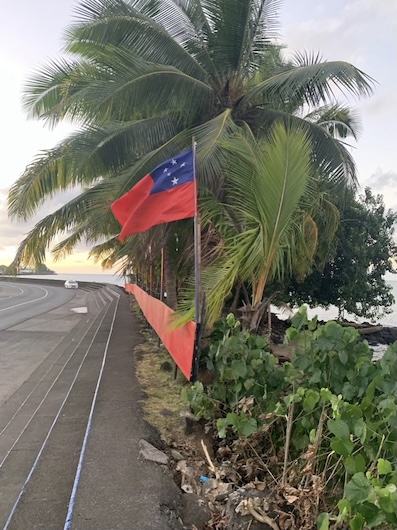
I returned to the Pacific in early June, and first on my itinerary was to spend a few days in Apia, Samoa. Little did I know that when I stepped out of the Faleolo airport that the country was in the middle of a five-day festival celebrating their 64th Independence. Samoa was the first colonized island nation to gain independence in the early 1960s. A new government was elected late last year, and they wanted to showboat a little and bring back the way the nation used to celebrate the holiday. The five-day festivities included traditional dances, music, lots of food, a long boat race, and other competitions- all of which were mostly centered around the town of Apia.
Arriving in Samoa I had a loose agenda. I didn't have any projects for the week, but I did have a few meetings lined up and many books to donate to various libraries around the island of Upolu. In fact, my bag was so heavy with books and archival supplies for Fiji that it got dented, a couple of wheels broke, and the zipper tore as it made its way across the Pacific. However, I was fortunate enough to not lose anything that I packed.
The first thing that I did was to pay a visit at the National Archive of Samoa. I donated my own books, The Barefoot Serenade, books one and two to the National Library, which is part of the National Archives. This library is primarily a Pacific Collection that was extracted from the center library in town and brought to the cultural center. The collection is growing and has vastly become a resource center for the Pacific. The librarians were pleased to add my books to their collection. I also donated a few other books containing information on the Pacific.
Last year I was part of their 2025 International Archives Week (IAW) and gave a workshop on archival and library preservation at the cultural center and on the island of Savai'i. Incredibly, when I arrived at the archives on this trip, they were in the midst of getting ready for IAW 2026, which was to take place the following week. The amount of work they put into putting on a program to show the importance of archives for the entire week that also included events on the island of Savai'i was quite inspiring. This year the program included presentations from traditional boat makers and traditional healers where information on these topics could be found in the archives.
Like last year I enjoyed tagging along when archive staff members made errands in preparation of IAW. It was terrific way to learn where things are in town. While we were out, they took me to the National University of Samoa where we met with the head librarian. I donated my books, The Barefoot Serenade, to their Pacific Collection and then we had a short talk on how I can help the library in the near future. One item that came up was that they wanted me to examine their disaster management plan. The one issue I noticed, however, was the lack of space for their Pacific Collection- the shelving was full and books were piling high on top of a couple of tables. This should be addressed as their collection is quite special and the books need to be arranged better for their longevity.
The next morning, I had a meeting with Vaveao Toa, who is the head archivist with the Ministry of Justice. Vaveao worked for the National Archives for over twenty years and had been a colleague and friend of mine for most of that time. She recently took this new position with the Ministry and has been in the job for a few months. Because the archives contain mostly active records, it is a stand-alone archive where the collections remain on site instead of being sent to the National Archives. Vaveao has a staff of about twelve employees. However, none of them have any archives experience. They spend most of their time pulling and filing records, mostly land related ones, for the courts. Thus, Vaveao wanted to discuss the preservation issues regarding her collection, and we're hoping to, perhaps, do a much-needed preservation workshop with her staff.
On my final day in Samoa I made a couple trips to other libraries. The first was at St. Theresa's Parish in Lepea. I donated a box of books for the library. More importantly, I donated a set of reading comprehension books for kindergarten to eighth grade. The donation was greatly appreciated by the principal, Sr Malia, and it will be added to their curriculum. In the afternoon I went to the library at the University of South Pacific, Apia campus, to donate my books to their Pacific collection. After this, I headed back to the National Archives where I spent the rest of my time helping them get ready for IAW. This included moving stands and promotional signs and cleaning the auditorium where the event would take place.
Although my stay in Samoa was quick, I was quite busy despite not having much of an agenda. It was nice catching up with colleagues and friends. There's still work to help with in the country, and I hope to return soon.
The Catholic Archives - Suva, Fiji
The following week I returned to Suva, Fiji where I have an ongoing project with the Catholic Archives at the Nicholas House next to the cathedral. I picked up where I left off when I was last there in October of 2025. Nobody had worked in the archives since then, so it felt like I had never left. Volunteer, Katherine Foi, also returned to continue her good work on the photograph collection.
This time around I happened to be there while Archbishop Peter Chong was working at the Nicholas House. He's typically in high demand and does a bit of travel. When I was there last year, he was away in Australia recovering from a life-threatening illness. Nevertheless, His Grace knew that I had been working in the archives since 2019 and decided that he wanted to get more involved with it. We had a quick meeting before he had to go to another meeting, but he wanted to know more. Thus, he scheduled a lunch meeting with Katherine and I the following day. This was unprecedented and was the talk around the Diocese staff. At lunch we discussed topics such as space and storage issues, future archive and library potential, and the possibility of hiring a part-staff member. It was the first time in the seven years that I've been coming to the Nicholas House that has taken an interest in the archives. This could bode well for us in the future when we try to get policies adopted for the collection.
The project continued as usual. I was able to finish preserving and processing several more shelves of collections, and Katherine finished processing another box with hundreds of photographs. We're now starting to feel like we have a handle on the collections, although there are a lot that we need to appraise, process and preserve. But we are making progress.
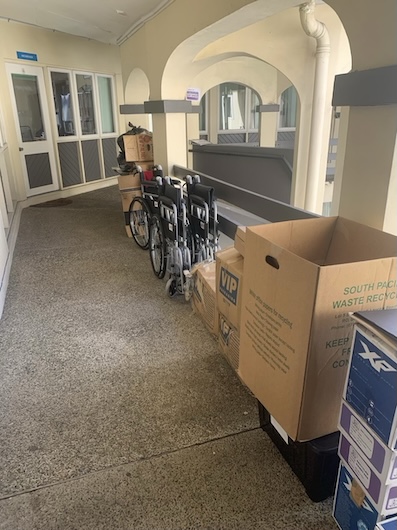
One of the biggest accomplishments of the week was that I was able to clean out the archives of items that don't belong there. For years the Diocese staff had the bad habit of using the archives as a storage room. The room is very small, and I had to share it with non-archival and library material. However, on Friday they decided to have a spring-cleaning day, and I took full advantage of it. I removed traditional mats, donated clothing, boxes of ephemera pamphlets, wheelchairs, boxes of office supplies, old newspapers, broken chairs, a box of communion bowls, and stacks of posters. It was a great day as I had been burdened by this stuff for years. Hopefully, going forward, the archbishop will help me keep the staff from using the archives as a storage closet.
The next step is to write recommendations for the archbishop. I'll look at what we discussed over lunch and put together a draft. Perhaps, before I return later in the year the archives will have a new part-time employee that Katherine and I could train. The additional help will be truly appreciated and might just speed up our progress to have this archive fully functional.